1create table invoice (
2  id        uuid primary key,
3  customer  uuid not null references customer,
4  amount    numeric not null check (amount > 0),
5  status    invoice_status default 'draft'
6);
04 / 06
Backend and data systems
APIs, databases and data pipelines that hold up under real traffic and real data. The part of a system users never see, and always depend on.
WHAT IT IS
The foundation everything else stands on.
Every screen, report and model depends on a backend doing its job: storing data correctly, answering quickly, refusing what it should refuse and recording what happened.
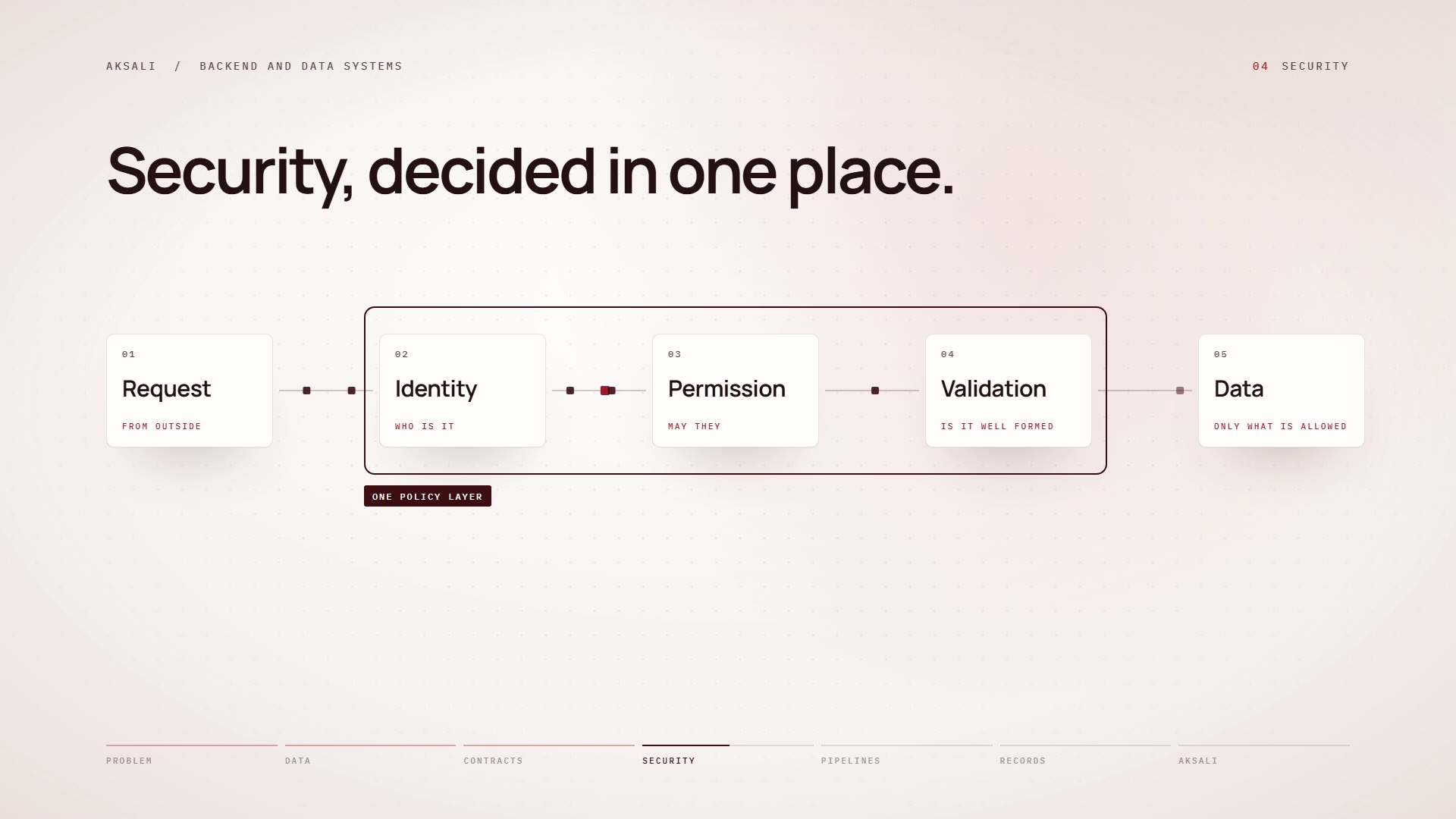
We design that layer deliberately, with data models that reflect how the business actually works, APIs with clear contracts, and security decided in one place rather than scattered through the code.
PROBLEMS WE SOLVE
What usually lies underneath
Symptoms appear in the interface. Causes usually live in the data model and the API.
- 01
Data you cannot trust
Duplicates, inconsistencies and numbers that differ between reports. We fix the data model and the pipelines that feed it.
- 02
Systems that do not talk to each other
Information copied by hand between tools. We build integrations with clear contracts and proper error handling.
- 03
Security handled by convention
Access rules spread across the code and hoped for. We centralise them so they can be read, tested and trusted.
- 04
Failures nobody can explain
Errors without logs and changes without history. We add structured logging and audit trails.
HOW WE WORK
From a data model to a system that can be trusted
Correctness first, then security, then speed, and a record of everything that happens.
01Model
Model the data
Entities, relationships and constraints are designed so that invalid states cannot be stored.
02Contract
Define the contracts
APIs have typed, validated inputs and outputs, so every client knows exactly what to expect.
03Secure
Secure by design
Authentication, authorisation and data visibility are decided in one place and tested as attacks.
04Record
Record what happened
Structured logs, audit trails and clear error handling mean every failure leaves an explanation.
WHAT WE PROVIDE
What we provide
API design and development
APIs with validated inputs, clear errors and documentation your clients can build against.
Databases and data models
Relational schemas, migrations and queries designed for correctness first, then for speed.
Data pipelines
Import, clean and transform data from files and services into a form you can rely on.
Integrations
Connections to third-party services, with retries, timeouts and failures handled properly.
Authentication and access control
Sessions, roles and permissions, including token rotation and least-privilege data access.
Logging and audit trails
Structured logs and append-only records of the actions that matter.
FILM0:54
Backend and data systems at Aksali, in one minute
From the data model to clear contracts, security in one place, checked pipelines and a record of everything.
Read the transcript
Every product stands on its foundation. The real question is trust: in the data, and in the system that holds it.
We start with the data model: what every record means, and how it connects.
Then clear contracts, so every system knows exactly what to send and what to expect.
Security is decided in one place, and checked at every boundary.
Data moves through pipelines that check it at each step. Bad records are set aside, never silently stored.
And everything that happens is recorded, so a failure can always be explained.
Systems that are secure, consistent and explainable. Aksali Technologies. Genuine engineering.
TYPICAL APPLICATIONS
Typical engagements
- 01
Build the backend for a new product
Data model, API, authentication and deployment, designed together from the start.
- 02
Clean up and connect your data
Scattered sources brought into one trustworthy model, with pipelines that keep it current.
- 03
Harden an existing API
Validation, access rules, logging and tests added to a backend that has outgrown its first version.
WHY IT IS DIFFERENT
Secure by structure, not by hope
Most data leaks are decisions made by default. We make them on purpose.
| Common practice | How we work |
|---|---|
| Hide sensitive data in the interface | Never select it in the first place |
| Validate in the browser only | Validate at every boundary, on the server |
| Add logging after the first incident | Design logs and audit trails from the start |
| Test that it works | Test how it could be attacked |
WHAT TO EXPECT
What you can expect
A direct line to the engineer
You speak with the person designing and building your system, from the first call to hand-over.
A written plan before we build
What we will build, how, what it will take, and how we will know it works.
Working software early
Short increments you can see and test, rather than one reveal at the end.
Honest reporting
Results reported with their limits, and a clear word when a simpler approach would serve you better.
Everything handed over
Code, documentation and what you need to run and extend the system yourselves.
Have data or an API you cannot fully trust?
Tell us what it does and what worries you about it. We will tell you where we would look first.
Start a conversation